


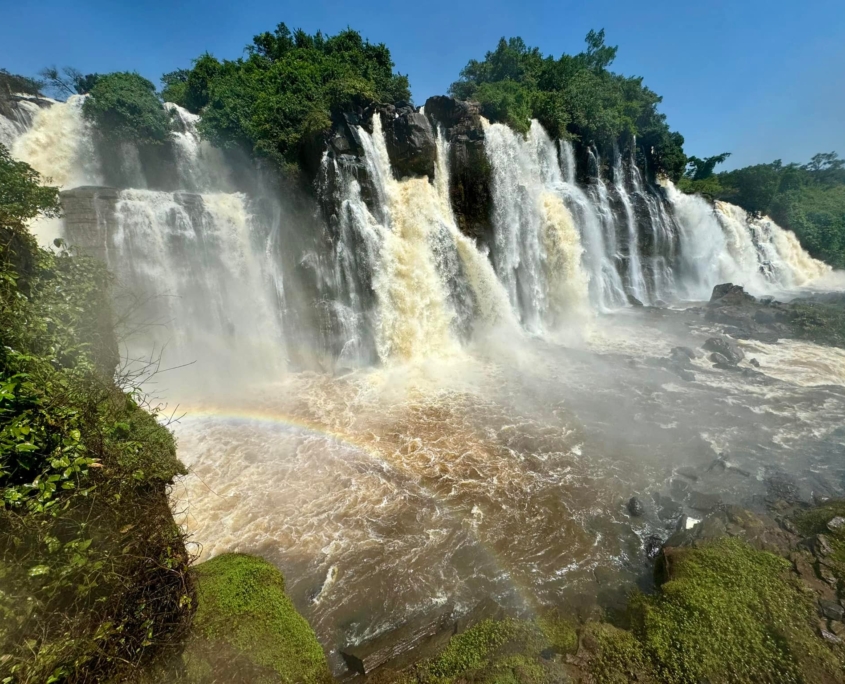
Often referred to as the Chutes de Boali, the Boali Falls Central African Republic remains one of the country’s most breathtaking natural landmarks. These spectacular falls emerge from the Mbali River, a major tributary of the Ubangi. With a dramatic drop of 50 meters (164 feet) and a massive span of over 250 meters (820 feet), the site offers a powerful display of nature’s raw energy.

To see the falls in their full glory, we recommend visiting during the rainy season between April and October. During these months, seasonal rainfall swells the river, creating a thunderous volume of water. If you feel adventurous, you can descend the mist-slicked rocks to the base of the falls. Be prepared, however, the intense spray will leave you absolutely soaked, providing a refreshing, immersive encounter with the river’s force.
Upon arrival, you will likely meet several self-appointed local guides. While they can be persistent, they possess an intimate knowledge of the terrain. If you prefer to explore the spectacle solo, a firm but polite “no” is usually necessary. If you do choose to hire one, a respectful tip is expected for their services. For those looking to stay overnight, the Motel Pierre d’Onyx, located at the entrance to Boali Village, offers the most convenient nearby accommodation.
Traveling to Boali Falls Central African Republic is a straightforward journey from the capital. The site sits approximately 95 to 100 kilometers (62 miles) northwest of Bangui. You can reach the falls in under two hours via the RN1 road, which remains in relatively good condition.
The nearby town of Boali holds deep historical and strategic significance. As early as 1926, it served as a hub for the cotton industry. Today, it remains the “electric heart” of the country due to its extensive hydropower infrastructure.
Just below the falls, the Mbali River fuels Central African Republic (CAR). The Boali Hydroelectric Power Station, recently rehabilitated through international collaboration, supplies 38.75 megawatts of electricity to Bangui.
Perched on the very edge of the waterfall’s precipice is a rustic gazebo restaurant. While the views are world-class, the service follows a “slow food” philosophy, literally. We suggest placing your order immediately upon arrival, then heading off for a hike or a swim. By the time you return, your meal might be ready. It is a perfect opportunity to embrace the slower pace of the African bush.

A review by a recent Kwafrika Travel customer to CAR:
My Central African experience was of fleeting beauty. While parts of the country remain effectively off-limits for standard tourism, navigating the capital city Bangui, we found a city where church services are celebrated with vivid color, markets like PK5 serve as essential lifelines, and community institutions, from the cathedral to the mosque, offer historical and spiritual landmarks. Navigating this environment demands a high degree of adaptability, Kwafrika Travel always got my back as the reality on the ground often involves dodging bureaucracy, negotiating checkpoints, and finding pockets of genuine human connection in a place that has been largely overlooked by the rest of the world.
At Kwafrika Travel, we frequently combine a trip to Boali Falls Central African Republic with city tours of Bangui or expeditions into the Dzanga-Sangha Rainforest. Whether you are looking for a day trip or a multi-week safari, our expert consultants are ready to craft your perfect itinerary. Contact us today to begin your Central African adventure.