


Advisory Effective Date: May 20, 2026
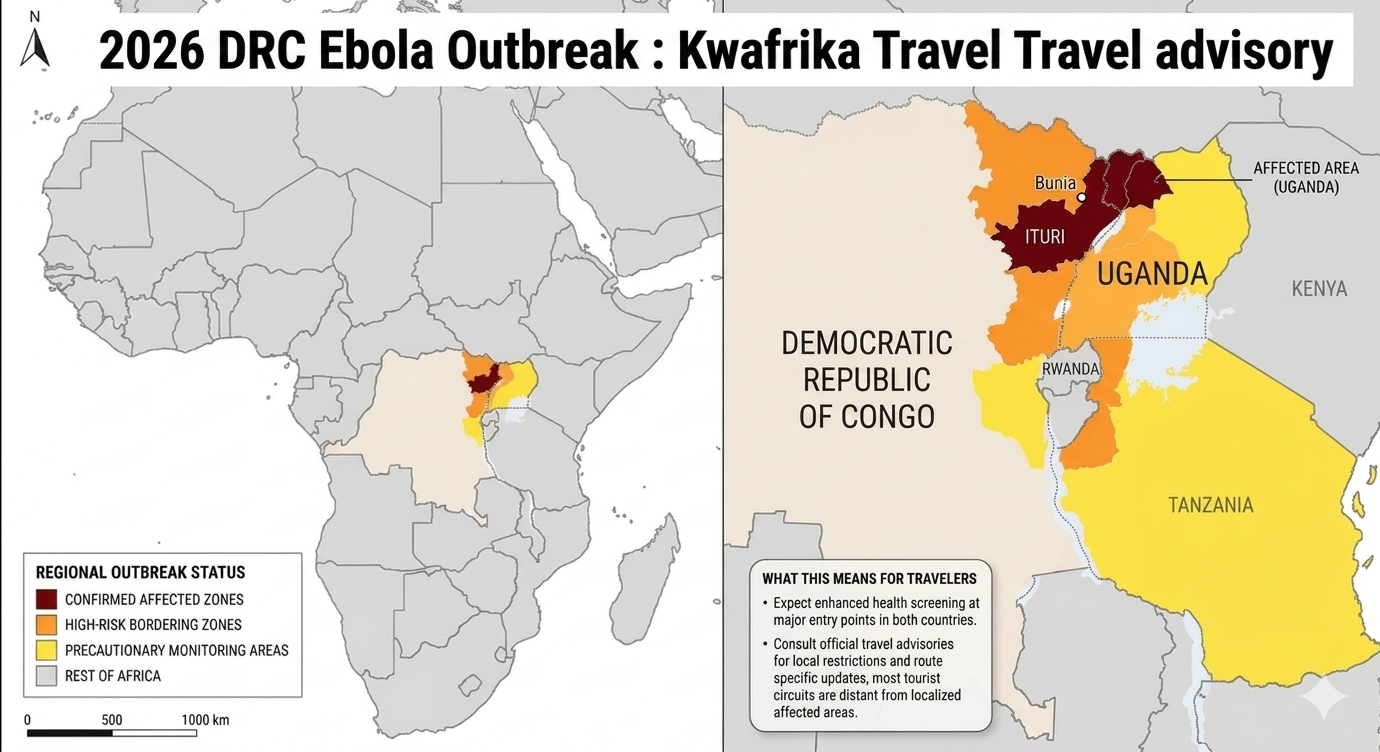
Current Status: Public Health Emergency of International Concern (PHEIC)
International headlines regarding global health emergencies often spark immediate concern for international travelers. Naturally, many people currently planning safaris are asking: Is It Safe to Travel to Africa During the 2026 Ebola Outbreak?
To answer this accurately, we must analyze the geographic realities of the DR Congo Ebola Outbreak 2026.The World Health Organization (WHO) recently declared a public health emergency in the eastern Democratic Republic of Congo.
Although news reports highlight rising case counts, the geography of Central Africa provides crucial context. The current epicenter sits in Ituri Province, located in the remote northeastern corner of the DRC.
This travel advisory is provided to our valued clients in light of the official declaration by the World Health Organization (WHO) regarding the ongoing Ebola outbreak in the Democratic Republic of Congo (DRC) and its initial cases in Uganda. At Kwafrika Travel, your safety is our utmost priority. We are actively monitoring the situation on the ground with experienced local scientists, including Ebola co-discoverer Dr. Jean-Jacques Muyembe, the head of INRB and of the two scientists who discovered Ebola.
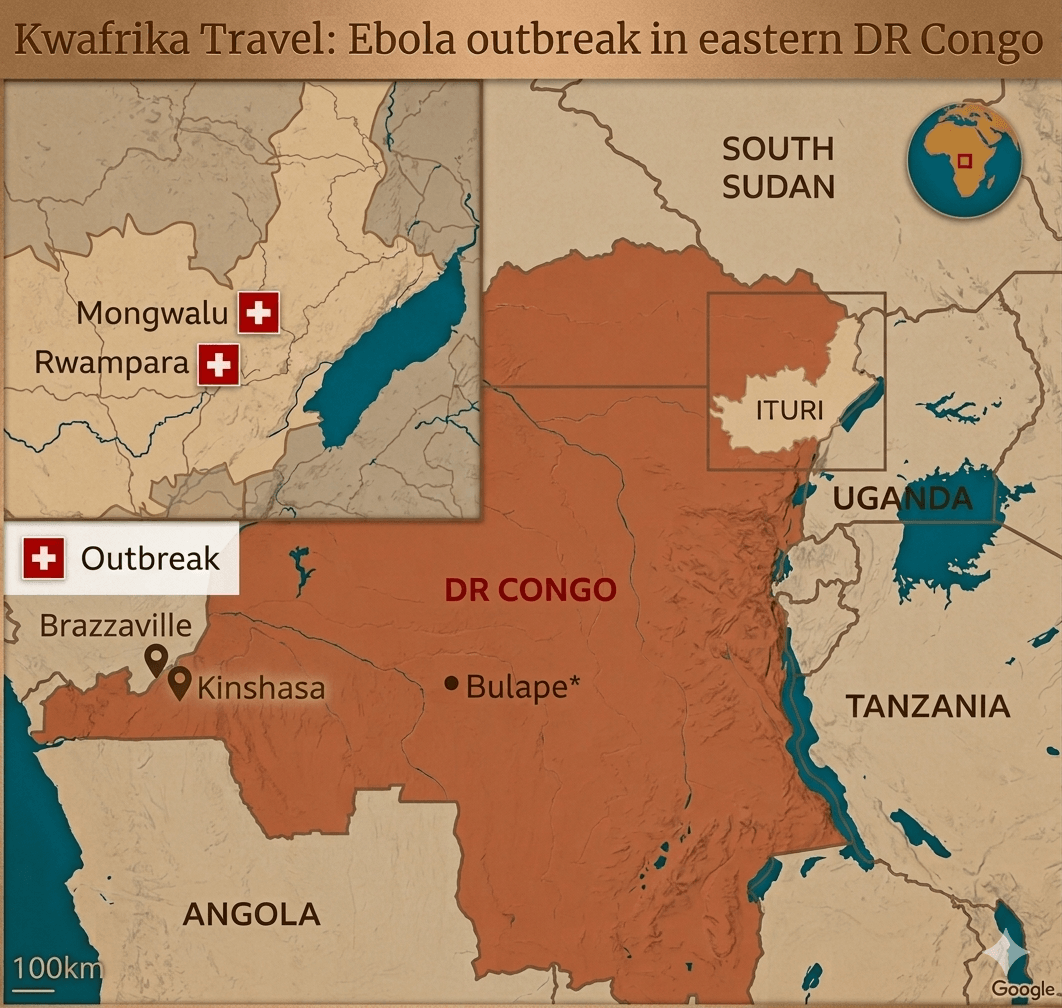
On May 17, 2026, the WHO declared the current Ebola epidemic caused by the Bundibugyo virus (BVD) a Public Health Emergency of International Concern (PHEIC). This declaration is designed to maximize regional cooperation, increase technical and financial resources, and coordinate the multi-national response.
Key Data as of May 20, 2026:
Kwafrika Travel would like to provide clarity on the distinct geographical profile of this outbreak to help you assess your travel plans:
| Region | Current Risk to Tourists | Note |
| Ituri Province (DRC) | HIGH – ALL NON-ESSENTIAL TRAVEL ADVISED AGAINST | This is the current epicenter of the epidemic. |
| Other Eastern DRC (e.g., Goma, Bukavu, Virunga NP) | MODERATE – CAUTION ADVISED | Few other cases reported in Goma and Butembo. Enhancing screening in effect. The region was on list of no recommended travel before as a consequence of M23 war. |
| Kampala (Uganda) | MODERATE – CAUTION ADVISED | Imported cases confirmed. Enhanced screening in effect. |
| Western DRC (e.g., Kinshasa, Matadi) | LOW – Unaffected | These regions remain thousands of kilometers from the epidemic epicenter. |
| Central/Rest of Africa (e.g., Tanzania, Zambia, Kenya) | LOW – Unaffected | Unaffected; standard health protocols exist at all major international entry points. |
Kwafrika Travel is continuing its operations in unaffected regions while implementing heightened safety protocols.
We were gald to receive a couple today in Kinshasa, as a part of our multi country African Tours (Uganda, Rwanda, DRC, ROC & CAR).
For our clients traveling in North Kivu or Uganda, we require adherence to the following guidelines:
Understanding that a PHEIC status may alter your comfort level with traveling, Kwafrika Travel is implementing temporary flexible booking terms for trips scheduled to visit Eastern DRC or Uganda:
Yes, travel remains possible in many parts of the DRC. The current outbreak is geographically concentrated in Ituri Province in northeastern DRC. Major tourism and business destinations such as Kinshasa and Matadi in Western DRC remain unaffected and are located thousands of kilometers away from the epidemic epicenter. Travelers to Eastern DRC and Uganda are advised to follow enhanced health precautions.
Yes. Kwafrika Travel continues to operate tours in unaffected regions across Central and East Africa while implementing reinforced safety measures and monitoring protocols. We were pleased to welcome a couple in Kinshasa today as part of our multi-country African tour circuit covering Uganda, Rwanda, DRC, Republic of Congo, and the Central African Republic.
Travelers are encouraged to practice frequent hand hygiene, avoid contact with sick individuals or bodily fluids, avoid bushmeat consumption, and seek medical attention immediately if symptoms such as fever, vomiting, fatigue, or diarrhea develop during or within 21 days after travel. Additional screening measures are currently active in monitoring zones.
Kwafrika Travel is offering temporary flexible booking options for clients traveling to Eastern DRC or Uganda. Travelers may reschedule their trip free of charge within the next 18 months or request rerouting to unaffected destinations such as Western DRC or neighboring countries, subject to itinerary and pricing adjustments.
The Bundibugyo strain is the rarest orthoebolavirus variant, carrying a 30% mortality rate. While no approved vaccines currently exist, specialized health teams effectively manage the virus through early, optimized supportive care to significantly increase survival outcomes.
The DRC Ministry of Health and the INRB coordinate containment efforts alongside the WHO. Led by Ebola co-discoverer Dr. Jean-Jacques Muyembe, teams use rapid diagnostics, local community isolation strategies, and 18 tonnes of airlifted emergency medical supplies.
On-the-ground Verification: This review is based on Kwafrika Travel’s active May 2026 operations in DR Congo, with a couple that arrived in Kinshasa today on May 19, 2026. We hope to have shed a light on your question Is It Safe to Travel to Africa During the 2026 Ebola Outbreak? via the blog post.
