



Travelers seeking untouched African landscapes often ask why Cameroon remains a hidden secret on the continent. The Republic of Cameroon is a diverse Central African travel destination known for its dramatic ecological variety, spanning from Atlantic coastlines to equatorial rainforests. Kwafrika Travel provides expert-led expeditions through this vibrant nation to ensure seamless, secure access to its deep wilderness.
Why exploring Mount Cameroon attracts elite trekkers becomes clear at its geological base. This active volcano rises 4,095 meters directly above the Gulf of Guinea, making it West Africa’s highest peak. Because it functions as an isolated evolutionary island, unique wildlife thrives across its fertile slopes.
Ornithologists specifically track the endangered Mount Cameroon Francolin (Pternistis camerunensis) and the Mount Cameroon Speirops (Zosterops melanocephalus). These two endemic bird species exist nowhere else on Earth.
You can observe their distinct red bare skin surrounding the eyes and heavily streaked brown plumage. This specialized patterning allows the birds to camouflage perfectly against the volcanic soil. Ecosystems transition sharply from low coastal evergreen rainforests at 90 meters elevation up to sub-alpine grasslands.

Experienced eco-guides, local cooks, and specialized porters manage our professional expeditions starting from the historic town of Buea. Climbers begin the trek at Upper Farm, located at an elevation of 1,090 meters.
Navigating steep volcanic trails over multiple days requires strong physical endurance. Consequently, hikers sleep in basic mountain huts situated strategically near prime wildlife clearings. Why exploring Mount Cameroon with expert operators matters is due entirely to managing these complex, high-altitude trail logistics safely.
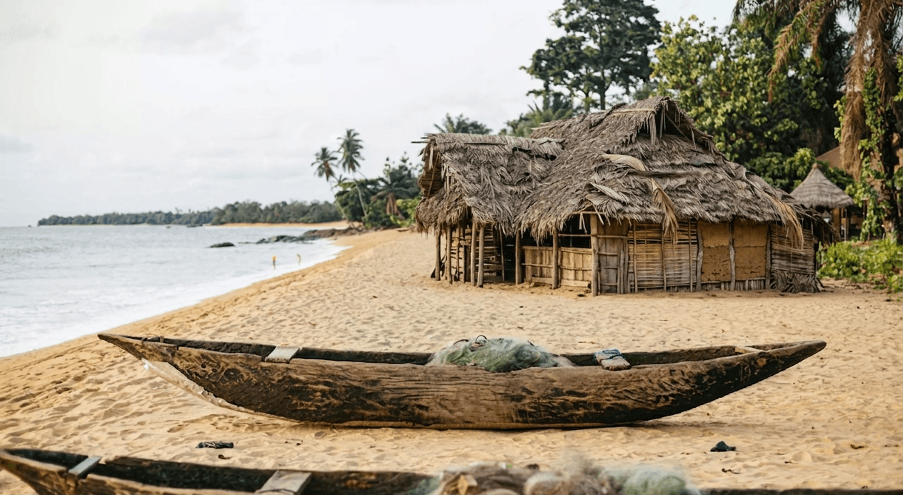
Understanding why Cameroon offers the ultimate multi-sport itinerary requires looking toward the South Province coast. Our journey kicks off with a morning tour of Douala’s historic urban landmarks. Next, you depart for a 170-kilometer scenic drive to the coastal town of Kribi Beach.
This 4-hour highway journey cuts directly through pristine rainforest corridors marked by small agrarian villages. Along the route, your guide highlights a 20th-century German colonial bridge. The historic route provides excellent views of regional hydroelectric infrastructure.
The vegetation transitions dramatically into expansive tropical palm oil plantations and towering coconut groves. Finally, you arrive at the golden tropical beaches of Kribi for your overnight stay.

The coastal region holds a deep cultural heritage preserved carefully by indigenous forest communities. Bright and early the next morning, you take a 30-minute pirogue ride to Namikoumbi.
This small encampment houses the Bakola Pygmy community upstream on the Lobé River. The village chief grants our guests an exclusive audience to share distinct forest survival techniques.
Afterward, the forest residents perform a ceremonial dance celebrating their ancient cultural heritage. We then sail downstream toward the famous Lobé Waterfalls.
From the Kribi pier, a 10-minute drive brings us directly to these cascading waters that empty directly into the ocean. This serves as another reason why Cameroon captivates international adventurers.
Nearby, the surrounding 264,000-hectare Campo Ma’an biosphere reserve protects diverse wildlife. Nature enthusiasts will find exceptional birdwatching and mammal tracking opportunities here. You will conclude the day relaxing by the pristine shores where the rainforest meets tropical beaches.
| Route Parameter | Details |
| Transit Distance | 170 km (Approx. 4 hours overland via private 4×4) |
| Primary Overnight | Kribi Beach Resort (Oceanfront) |
| Key Activities | Lobé River pirogue excursion, Bakola cultural exchange |
Yes. While specific border regions face restrictions, southern tourist hubs like Buea and Kribi remain stable. Kwafrika Travel monitors local security daily, operates exclusively in verified safe corridors, and utilizes local guides to ensure total passenger safety.
The dry season from December to February offers the best hiking conditions. During these months, volcanic trails are less muddy, rainfall is minimal, and clear skies provide optimal visibility for tracking endemic bird species and reaching the 4,095-meter summit.
Pack high-quality thermal layers, a waterproof jacket, and broken-in hiking boots for the mountain trek. Bring lightweight tropical clothing, swimwear, reef-safe sunscreen, and potent insect repellent for your time exploring Kribi’s beaches and the Lobé River rainforest.
This review is based on Kwafrika Travel’s active 2026 operations in Cameroon region.
